Total Pageviews

Greetings!

'A gaping silken dragon,/Puffed by the wind, suffices us for God./We, not the City, are the Empire's soul:/A rotten tree lives only in its rind.'

Saturday, 20 February 2016

Rescued...

... from ignominy.

Have I spelt that correctly? Which reminds me of the original bit of  Dad's Army's repartee from the very early days when the boys are joining up:

Mainwaring: 'Occupation?'
Fraser: 'I own a philatelist's shop.'
Mainwaring: 'How do you spell that?'
Fraser: 'S. H.O.P. Shop'.

Now, back to business.  Those of you who have been paying attention will know that some months ago, I began the very simple task of kit-bashing the old Airfix 'snap-together' Me Bf109 G-6. The idea being to add another aircraft to my small, late war Italian, Aeronautica Nazionale Repubblicana (ANR) collection. Surely there could be no problems for a kit basher of decades? Mmm, well, apart from the rather basic nature of the cockpit, which was remedied with one of Yahu's quite marvellous 1/72 instrument panels, it should have been a piece of carrot cake.  But.  But, I didn't wash the parts, so when it came to removing the masks, the paint came off in strips. Then I left the masks on the canopy for too long, and the tape welded itself to the 'clear' plastic. Then I broke off the tail wheel. At that point, I did something I have never done before, I gave the thing up, and left if to gather dust in the shed.

But, I just couldn't leave it. Even though I moved onto British bi-plane bombers and German jets, while waiting for lumbering Whitleys.  So, chastened, I brought the 109 in from the cold:


Above, after I'd started to rub down the damaged paint  job.


Primed, again, looking a bit better.

 
Basics done. I can never get the German 'graus' right, even when, supposedly, using top stuff - here, Xtracrylics. I mixed the hellgrau, but ended up with too much hell and not enough grau.


And, above, as it looks at the moment. The markings come from a 20-25 year old set ('Blue Rider' perhaps), and I've already used up all the stencils, so it's just the basics, but as they incorporate a nice combination of wing fasces, fuselage balkenkreuz, tricolour and blue chevron, it looks quite neat. All that's needed is some washes, a bit of weathering, aerial, and matt varnish.
 

Above is a photo of the original (including DF loop - not on my version!) from the excellent tome by Nick Beale et al.

All that has rather re-whetted my appetite for Me109s - especially as I have a very, very unusual one sitting in its box. One that does not require mottling.  But, on the other hand, there is the He floatplane waiting, all clean and ready to go; not to mention the Whitley, which could, just could, be on the way... (especially now Hornby have sacked their CEO).

Sunday, 10 January 2016

From the sublime...

... to another type of sublime...

The marvellous Heyford, which featured in my last post, was still (just) in first-line service with the RAF in August 1939, when another aircraft took off for its initial flight. That aircraft, the He178 V1 is seen here with my Matchbox Heyford:


A tad smaller, as you can see.
 
 
The first prototype He 178 later received longer span wings, and a retractable undercarriage, but the RLM wasn't interested, and there was no production version.  The model is by 'Special Hobby', and is short-run:


The fit overall isn't great, but ok, and would be even more ok if I was more than a mediocre kit-basher. Still, the diminutive kit was a change from my Christmas hol Heyford bash. 


Poor finish in evidence here - the Humbrol acrylic seemed gritty, no matter how I stirred the pot. Odd.


I had hoped to have my hands on one of the new Airfix Whitleys, which  have on order at my local, independent, sort-of-a-model-shop.  But the proprietor tells me that he is having real problems with Airfix, and thinks they are playing tricky games. He says that they are announcing kits, putting them in their online catalogue, and taking orders, all at an announced price. However, it is taking a long time for orders to appear, and the prices have then been raised, sometimes considerably - he gave me an example of one of their 1/72 V bomber kits. All rather naughty - trying to see what price the market will bear. That's fine (it's known as 'cost-plus pricing'), but seems a bit underhand when done in that way.

Thursday, 31 December 2015

PEACE and HEALTH...


...in 2016 to you all!
 
 
Contrary to all the rules of good blogging, I have neglected my duties here, and posted little. I had, indeed, thought to let these pages wither on their electronic vine.  But, perhaps not. What is started must be finished.  That, in kit bashing terms has been increasingly not the case. Old age? Too much in the way of the diurnals? Jaded?  Probably all three. However, with the onset of the Christmas and New Year holidays, I determined to kit bash something in the 'classic plastic' line. Inspired by an article by Jonathan Burns in Classic British Bombers, edited by Gary Hatcher (by far the best plastic aircraft modelling magazine editor), and armed with:
 
 
a 48 year old copy of Profile's The Handley Page Heyford, I set to on a 35 year old Matchbox 1/72 of the same.  Jonathan Burns' article was very useful, in particular his hard-won advice about getting the engine nacelles absolutely smooth on the top, to ensure proper wing mating. I didn't take photos of the Heyford as a work in progress, but here's a few (poor) shots of it on the shelf:

 
Marvellous beast. Pilot sat 17 feet up in the air, fuselage mated to top wing, giving excellent upper hemisphere vision, main bomb load carried in thickened centre-section of lower wing. That lower wing, and other devices, meant that the Heyford could be refueled and re-armed within 30 minutes - hence the manufacturer's monika - 'the Express Bomber'.


Not that it was 'express' in any other meaning of the word, with a top speed of 134 mph. Mind you, it was a dedicated night bomber, but, still, for a 1936 bit of kit, somewhat slow. Had the Munich Agreement not happened, it would have been the RAF's main weapon in any bombing of Germany.


Withdrawn from frontline service days before the UK declared war on Germany, it was replaced by the Whitley - which, very happily, has recently been released by Airfix...  can feel a 2016 kit bashing theme growing.
 
In other news, my son, who for so many years has been a denizen of the DARK SIDE of wargaming (i.e., the weirdness that is Warhammer and 40K), has, I hope and pray, seen the light. He has now started a new Old School project, which can be viewed here at The Molgravian Gazette. Please visit, and encourage him - it will make an old man very happy...


Sunday, 8 November 2015

Brnad falls!!

It's some time since we heard of fighting between those two old enemies, Maltovia and Lovitznia, but word has reached us this day of the apparent fall of Brnad. 

When last we heard from that old frontier town, the failure of the so-called 'Liberal' government to see to the proper defence of land and people, had led the Maltovian National League to organise a militia (see our last report here). Despite the continuing threat of the warlike, and expansionist Lovitznians, little more has been done by the corrupt, defeatist 'Liberal' government. And now this:


Above we see the poorly garrisoned walls of Brnad, with merely half a regiment on the walls, and the MNL mustering at bottom left.  In the far distance can be seen the regiments of Lovitznia, and, beyong, the two fiendish generals (said to be father and son), lowering over the scene.


The above photograph shows the Lovitznians in their dash to the walls, shaking off limited casualties from ineffective artillery fire, and facing the very limited firepower of the MNL. It was rumoured that a reserve regiment of the Maltovian Army was on its way, but bad going (and appalling dice luck) meant that the regiment in question:

 
arrived too late (above) to prevent this awful event:

 
the entry of those brown-tunic'd devils of Lovitznia into Brnad.


The situation, as we go to press, is shown above.
 
 
This means war!  And authorities on the subject suspect that the days of the 'Liberal' goverment are numbered!!
 
 
(Rules: Ross Mac's 'A Rattle of Dice')

Monday, 5 October 2015

Gustav...yahu

Many moons ago, I left the blog, saying I was about to snip sprue on a late mark 1/72 Messerschmitt for my sort-of collection of Italian Social Republic aircraft. Time and tide went. I toiled in my place of employment. I spoke at an academic conference. I lifted potatoes. I took trains the length and breadth of England (for work). I was ill. All the things that eat up 'the days', as in 'what are days for?' (I've been on a Philip Larkin trip of late).  Finally, finally, I turned my attention to the Airfix Bf109 G-6. Not a bad little kit, but:

 
As is apparent from the fuselage parts, at some point this moulding has been marketed as a 'no glue', 'snap together' kit. The problem with that is that, excepting a seat with a hole (for the pilot to snap into), there is no detail whatsoever for the cockpit. Blast. Well, I made up a few spurious bits and pieces, added a harness to the seat, and cut a crude plasticard instrument panel. The latter looked horribly basic, but then...


A note in one of the scale aircraft magazines directed me to Yahu! Excellent Polish chaps who produce very nice, and very cheap 1/72 instrument panels - see above (that's a 2cm square on my cutting mat). Highly recommended, especially as the UK supplier, Story Models,  seems tip-top - I ordered last Friday afternoon, and had a lot of little instrument panels today, Monday.


I was recently in Budapest, for work reasons, but had the opportunity to have a look around. For a child of the Cold War, Budapest, of course, resonates. The centre of the city, both sides of the Danube, has, naturally, been much upgraded since the end of Bolshevism in Europe. Nonetheless, even the rather magnificent frontage of Cornivus University bore subdued traces of both the terrible siege of 1944/45, and the 1956 Uprising. But good workmanship, and neat paintmanship, meant that one had to look carefully.  But that wasn't always the case, and I came across this building that bore more obvious traces of the city's torment:


More pleasingly, there was this sign (from the 1930s ?) over the entrance to a quiet, refined, and, for the non-Hungarian speaker, vaguely puzzling bookshop:


Sunday, 16 August 2015

Civvie Hell Part II...

There was a good deal of filling and sanding required, and perhaps it that was all the greenstuff dust that addled my brain. Or perhaps I'm just addled. Anyway, I super-glued the wings together, using super-glue with hopes of avoiding too much filler for the wings. Actually, that part of the plan worked quite well, and I was able to sand the leading edges nicely, using the squeezed out super-glue as filler. All very nice. Only when it was all done did I realise that I had failed to add inserts into the wings that would act as the locating positions for the undercarriages. What the actual fork?! At this point I nearly opted for seppuku, or something similiar but not quite so eye-watering. In the end, I broke the wings open...

The rest of the build went reasonably well, but with the thing more or less complete, I wasn't looking forward to the decals. With good reason:

 
One of the things that the masters in the scale aviation press endlessly foam about is modern decals - 'lovely and thin' blah, blah. Yes, lovely and thin. Just ripe for folding on themselves!! I knew, of course, that there was no way to get the very long decals on in one piece, so I cut them into smaller sections. But, it wasn't enough, as the key pieces curled in the water on both axes.
 
The only solution was scrape the mess off when dry, and use a sharp marker pen.
 
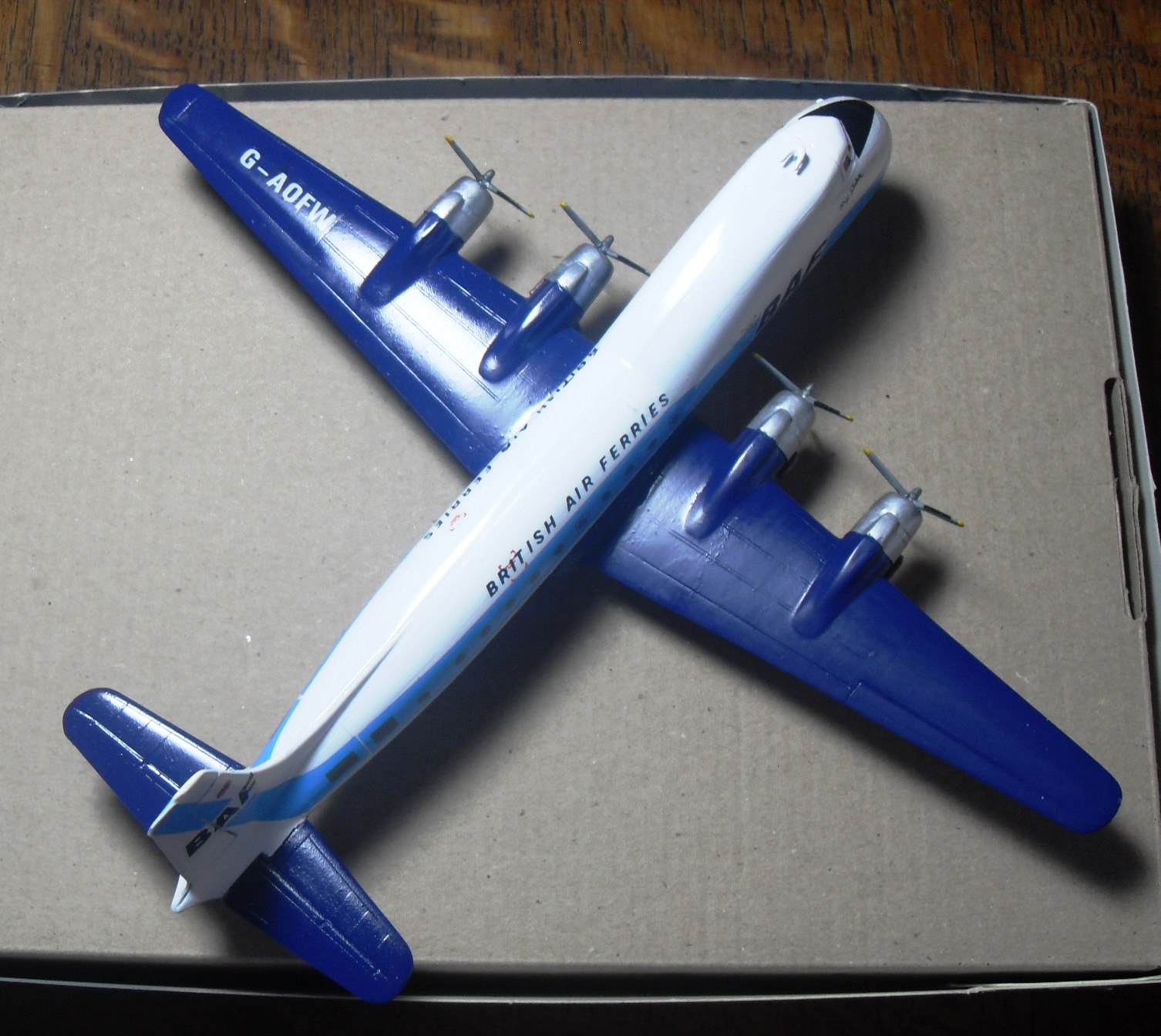
Still, in the end, it looks ok:


But, enough of the shiny finished civvie stuff.
 
Next up, late mark Messerschmitt madness:


But, which one. Oddly, only one is short-run....

Saturday, 15 August 2015

Civilian hell...

... or review build: Roden, Carvair ATL98, 1/144.

I understand that Hollywood stars refer to the non-actor world as 'the civilians'. I refer to the 'stars' as degenerates who are part and parcel of the decline of the West. But that's neither here nor there, as here is...

civilian model hell.

I've had a short run of 1/144 kit bashing recently - Tupelov 'Badgers', Vickers Valiant - so I thought that I would go for an interesting civilian 1/144 in the shape of the Carvair. This was a British conversion of the Douglas DC-4, turning that passenger aircraft into a car and passenger carrier for the days when one might think of taking the Rover, Jag, or Austin Cambridge, over to the Continong (Europe, that is) by air. It was the bright idea of Sir Freddie Laker, a rather famous, and innovative figure in British post-war aviation, whose efforts to bring cheap air travel to the masses were crushed by the dead hand of state-sponsored airlines.  So, what do Roden give us in 1/144:

 
A rather nice bit of box art, very atmospheric, top banana.


In addition to the wings and fuselage, three sprues of softish, grey plastic. These make up into:


Touch where it fits hell!  Yes, I forgot to mention that despite my repeated assertions to the contrary, I've been messing around with a short-run kit again! O me miserum. 


Just look at those gaping trenches in the fuselage halves and the wing roots.
 
 
But, things got worse....
 
 
To be continued...