Total Pageviews

Greetings!

'A gaping silken dragon,/Puffed by the wind, suffices us for God./We, not the City, are the Empire's soul:/A rotten tree lives only in its rind.'

Friday, 25 April 2014

Groundhog...

...Day.

Or deja vu all round. As most of us are aware, the Ukrainian/Russian crisis rumbles on, with various actors inside, and outside, those countries playing what may well be a rather dangerous game of silly buggers. I will resist the temptation to comment about multi-national states, partition, and disputed borders (we in the UK and Ireland, have had our own problems in those respects). However, the whole business is a tad depressing, though not without ironic light relief. The latter comes in the form of the totally unelected EU foreign policy Generalissimo, Baroness (how apt) Ashton, lecturing Putin on democracy. Putin is, of course, elected. But I have been a bit surprised at the speed with which parts of the UK media have wheeled out the Cold War rhetoric. However, every cloud, etc etc, and the BBC kindly supplied us aero-enthusiasts with some marvellous photographs of Russian 'Bears', intercepted by RAF Typhoons. They are well worth a look - here. Absolutely marvellous photographs - just look at the different finishes on various panels ! Aaaaah. But, more seriously, why show us this now, when, of course, it is a pretty standard event, ever since the temporary grounding of aircraft after the collapse of Bolshevism. Why now ? Why refresh old images in the minds of a good slice of the population?

And, that, of course, brings me to modelling Groundhog here at the Hobbit Bunker, in the shape of:

 
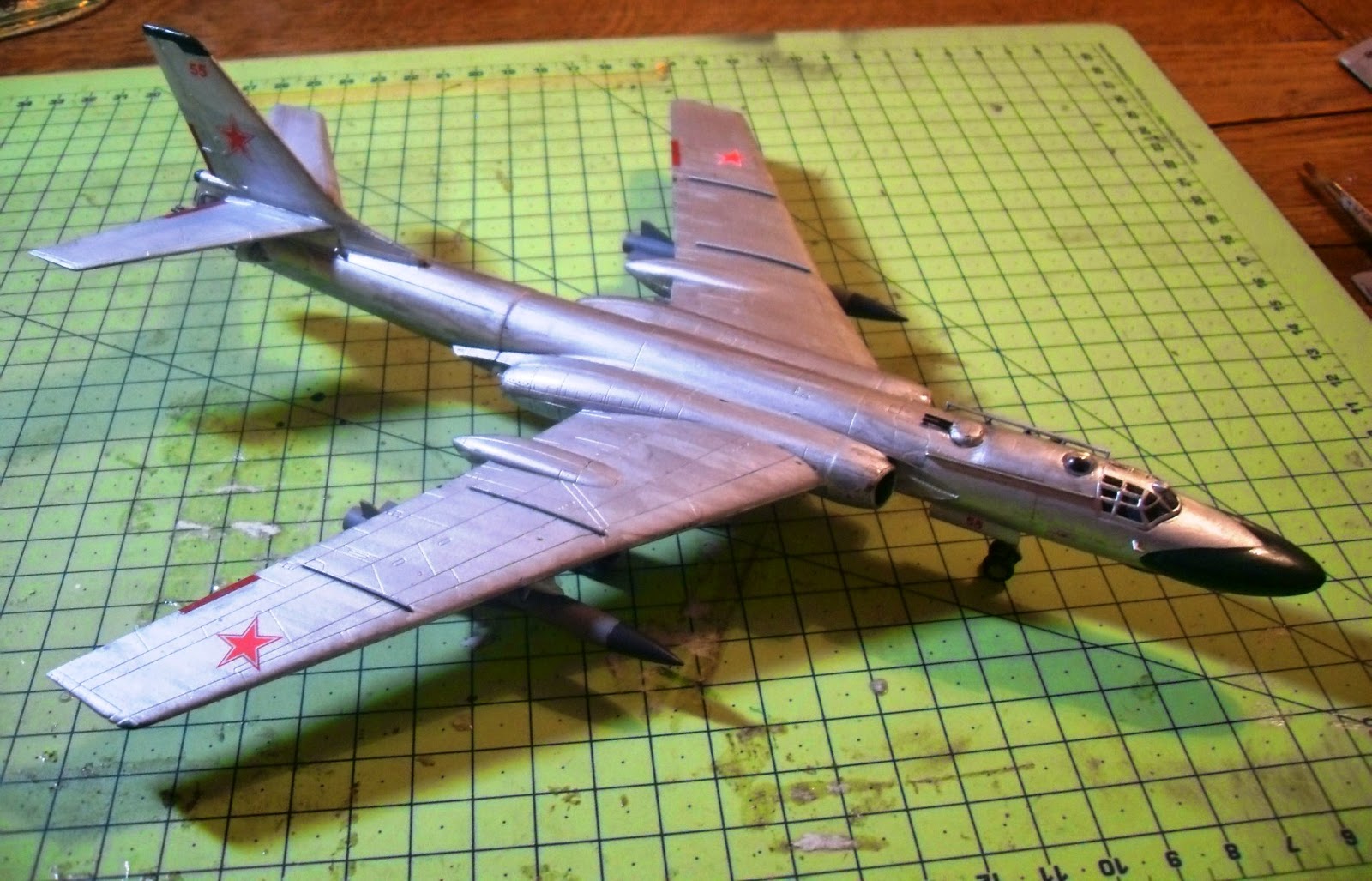
Yes, another 1/144 Badger, but a Badger G. Unlike my previous Tupelov, this one is being finished in over the water camouflage - gull grey over white:


I am clearly on a aircraft kit bash streak (although I have no idea at all where I will be able to squeeze them in among my packed shelves). I'm also into a long-range, sea strike mood, and last week I picked up:


Now, I intend to finish this Heinkel He115 B as an Heinkel He115A (as far as  can establish, there were no external differences between the two) of the Norwegian air force. But there is a tricky bit. My trawl of the internetosphere has come up with only three images of Norwegian He115s. Two appear to be pre-war, and one is, apparently, a photograph of one of the aircraft which escaped to the UK. The pre-war finish appears to be overall aluminuim/silver, while the escaped version has a heavy, field applied, random camouflage applied to the upper surfaces, but the colours are almost impossible to determine. Has anyone got any more concrete information on either finish???


As you might expect of a toy soldier/kit bashing/war gaming odd bod, I also have small collections of other bits and pieces - or artefacts, if you will. I'm particularly pleased by a new acquisition to my small collection of Staffordshire figures, I think it is Grace Darling, and it is probably from the 1850s/60s:
 
A very nice piece, with overloaded cobalt that ran. One of millions, and a reminder of both of bravery and domesticity from times past. The figure to the right, by the way, is a modern figure but executed in a nice classic style. It is 'Napoleon', but looks like Rabbie Burns dressed for a party.
 
 
 In Old Blighty, Spring is well and truly here, and this is the view from my back window out into my tiny garden:

I enjoy this view as free Englishman with thanks to the men of the ANZAC. Long may their memory live.

Monday, 31 March 2014

Aaaaaaargh....

.....and aieeeee!

Not only has work and life been stupidly obstructionist this past month, but when I found, at last, a moment to post on my feeble kit bashing efforts, I discovered that my work managed laptop, having been totally reconfigured, no longer liked to copy images from my portable device. What a lot of new words - laptop, portable device...blah, blah...all the jolly new words that have entered the English language in my recent-ish lifetime, just like Taliban, jihad, fatwa that sort of thing. It must have been a tad better in the past, when we picked up buckshee, char, chit-chat, bint, fella, kibosh, all useful, benign words. Anyway, enough of all that, time to see if I have cracked the newly reconfigured bloody hell machine:


It works! It works! As you can see, I've been having fun with the rather marvellous Cold War warrior, the 'Badger'. I was rather taken by an enthusiastic build by Karl Robinson in the February issue of Scale Aircraft Modelling (SAM), and got myself a 1:144 one by Trumpeter. After the awful time I had with the new Airfix Vampire (see passim) , which I hasten to add was all my own fault, I can report that the Badger was most enjoyable, and I think that I may have found a new enthusiasm - large-ish Cold War warriors in 1:144.

First up (below) was the cockpit, not much of which can be seen in the end. But, as you can see, I had a bit of trouble trying to get an approximation of the unique colour that the Soviets painted the cockpits of their aircraft.


Then, the weakest part of the whole thing:


Trumpeter produce different variants of the Badger, which probably dictated the fuselage construction, which in turn needed a fair amount of filler fore and aft. Mr. Robinson in his SAM build did a very good job at filling and sanding away the joins. Not so Mr Front:


Nonetheless, a rather pleasant kit bash. So much so that I've ordered another, and stocked up on Humbrol metalcote, which is good to work with, especially for an old brushist like myself.


While I was slowly bashing this kit over the past month, the whole Ukraine/EU/Russia/Crimea/Putin business was playing itself out. I was, I must admit, a bit surprised at the rapidity which the UK's journalists and mainstream politicians went for old Cold War style rhetoric at the drop of the hat, not least because it was the same politicos who have effectively dismantled the UK's armed forces. Not quite sure why one would want to go around trying to pick fights while championing cuts to the military, especially given the failure of Basra. In fact, mentioning Iraq brings John Kerry's laughable comment to mind - the one about not being able to go round invading countries on jumped up excuses. Uh? Pot, kettle ? Who said the US doesn't do irony (even if unintentionally).

Monday, 3 March 2014

What alchemy...

... has the good Herr Doktor Front been engaged in ? Why has he not updated his flaming blog?

Well, the Vampire struggle continues. Rescued from the shed, it has, this very evening, begun to receive its myriad decals. When did 1/72 aircraft kits begin to have more markings and stencils than they have parts? It's no good thinking that one can omit some of the stencils, the very small ones at least, because they will just call out from the decal box. They will call, in sad, thin voices, in the late watches of the night, when, as Nietzsche said, 'the thought of suicide is our only comfort' (well, he was a mad old beggar). So, decals, half done:


They are admirably thin decals, and, as you can see the roundels are in good register, with nicely opaque whites. But with the thinness comes the dreaded curl ! And, horrors, I discovered that on the yellow, they have an instant stick quality that has already seen one casualty (fortunately, I have a spare set of decals). When I make the next T11, it will be a Rhodesian version - no markings at all, not one !

Apart from the continuing struggle with micro sol and set, I was able, this past weekend to :


pitch my little green tent (not unlike Snufkin's, though of a more modern form). A tent of this size used to be known as a 'pup tent'. Roomy for a pup, a squeeze for Alf, but light, and weather proof, and, above, in a small wood not from the village of Plumpton Green (yes, there is such) in the noble, beautiful county of Sussex.

From my tent, I journeyed out on Saturday morning, in amazing sunshine after rain, so much rain. First to the parish church of Streat:


Built on the site of a Saxon church by the Norman invader, this form is typical of this part of the county. Fairly plain, solid, simple, and with a turret, as opposed to a tower. From the church at Streat, I walked and slid a few miles across country to Ditchling, and sat in the church yard there, opposite this beauty:


The 'new' part of the house is, of course, the Elizabethan half-timbered structure on the right (part of the 'Great re-building', as the agrarian structure of England began some profound changes, and, some of the stolen silver began to tell - stolen by our English forbears from the Spaniards, who had stolen it from...the old story). The rest of the house, and it is still a private house, is a marvellous medieval structure, holding itself up with a series of drunken walls and a massive chimney breast. England made flesh, or, at least, made solid.

More recently, from inside St. Margaret's, Ditchling:


This is one of the crosses that marked a British soldier's grave from the Great War. Many were brought back to England (and the rest of the United Kingdom), as these temporary markers were replaced with the permanent ones that we are familiar with. Most of these temporary markers were then burned, ceremoniously, in parish church yards as part of Easter ceremonies following the war. Interestingly, the use of the cross as a grave marker in England had fallen out of use after the Reformation, but the huge citizen armies of the Great War brought back with them, from France and Belgium, a rekindled preference for the cross as a marker of Christian men. And, of course, there was the Kipling designed 'Cross of Sacrifice' that is the norm for many Imperial and Commonwealth Grave Commission cemeteries.

Then, I climbed out of Ditchling, up onto the Downs, and stood with Sussex, Surrey, and Kent before me:


land that the Saxons gave English names to, after they had breached the Romano-British coast.

And, finally, I rested:


'At this place the flat water-meadows, the same that are flooded and turned to a lake in mid-winter, stretch out a sort of scene or stage, whereupon can be planted the grandeur of the Downs...'
(Belloc, The Four Men (1904).

Sunday, 23 February 2014

PSC Pz IV endstates...

... just when one wants fly-by-the-seat-of-one's-trousers' photography to work reasonably well, someone infects the kit-bashing, toy soldier blogosphere with a desire to become a keen amateur. The impact has spread, on undoubtedly occult and arcane lines even unto this blog! As a result, my photographs of the Plastic Soldier Company Pz IVs are poor, even by my standards. So, you will have to forgive, and use your imagination:


Above and below, two of the PSCs constructed as Pz IV ausf. H.


The camouflage pattern on the side skirts was lifted from photographs and a colour plate from Hilary Doyle's Osprey on the late mark Pz IVs - a very useful reference.


And, the remaining kit from the PSC box of three, finished as a Pz IVF1 for Rommel:


Below, the PSC version is accompanied by an out of focus Frontline Wargames resin Pz IVD (does anyone remember the marvellous Airfix Magazine article from the early 1970s which celebrated the arrival of the Airfix F1/F2 with conversions to a Pz IVD and a Pz IVJ ? The former was very nicely presented,  I remember, with crew emerging from every turret hatch, and a peasant woman (and duck?) greeting them as liberators (eastern Europe, and early, then, but not Poland in any case; though perhaps Polish-Galicia).


And, below, the PSC on the left, with a 30 year old Airfix version on the right. The Airfix version has endured some 10 house moves in that time and has only lost one half of the turret hatch!


You can see that there is a noticeable 1/72 v. 1/76 difference here, but as one whose wargaming mind was formed in the days when the wargaming clergy were happy to mix 1/76 with 1/87, I don't really care.

So, what's the verdict on the PSC Pz IVs ?  In a word, worthwhile. There are detail issues, for example, the notek light is merely a raised blister, and there are, if one knows enough, issues re the rear of the hulls, and, probably, with the turret side hatches, but they look the business for the wargames table! They are excellent value for money, you get three at once, and you don't give sterling (TM, rUK) to the Chinese (I see the US think China is shaping up for a bit of aggro over Japanese islands).

Friday, 21 February 2014

Ochre...

... cheered on by DaveM, I went for the ochre look for the PSC Pz IVHs:


Here they are with the base coats in place. I used Revell acrylic ochre, which, like all the Revell acrylics is pretty thick, not far from being a paste - rather apt I suppose for German late war tank painting. So, this is what three pretty heavily diluted coats looks like over the black undercoat. Reasonable, I'd say, and, yes, I really do think I prefer the more yellowy look to the greeny hue.


And, being Friday, it was time for a beer:


 Brakspear (pronounced brakespear) Oxford Gold. I'm an Oxford man myself (Nuffield and Wolfson), so I'll have to say it is a fine beer - and it is! Light, clear tasting. Good stuff.


And I like the bee emblem too. Bees and beehives have a long history as symbols, of course; first because of sweetness - 'out of strength came sweetness', and then of a native, English, socialism. By the early 19th Century, the English working man and woman used the beehive as their political symbol - much, much more useful and gradualist a symbol than that which emerged from the twisted imaginings of German philosophy. The hammer and sickle was little but a threat, but the beehive and the bee - good enough to adorn an ale.

Wednesday, 19 February 2014

Chaos...

... totally inappropriate quotation from Shakespeare to start with: 'If I love you not, chaos has come again'. For two adult sized chocolate buttons (new product from Cadbury's - doing its bit to make sure that the British keep up in the global fat race with the USA and Australia), who said that and in which play?  Actually, it just goes to show how the English Midlands (where Dottore Front lives) is a cultural powerhouse - Shakespeare and Cadbury's chocolate.

Anyway, as I was saying, chaos rules on the modelling table, with the hateful multi-poise horrors taking pride of place:


Oh, how I hate multi-poise!! But, on the up side, PSC provide a nice mix of gunners with smocks (excellent for LFD men), and in standard uniform.

Also on the chaos front:


The PSC PZ IVHs - sitting, sulking, in their undercoats, waiting for me to go through the usual dunkelgelb agonies. Do I go for more 'greeny', or more 'yellowy' ? Some time ago, DaveM posted on this blog with a range of options, but, sadly, I am still tormented when it comes to dipping the brush into the chosen pot.

Finally:


the chaotic Vampire (please, DO NOT 'CLICK TO EMBIGGEN' as the Irish peeler say).

O me miserum!!

Monday, 17 February 2014

LwFD...

...or FD(L), or LFD...

depending on when exactly, and if you are speaking German or English. Longer term readers of this blog (yes, Mum), will know that I have a 20mm soft spot for the Luftwaffe Field Divisions, and have occasionally gamed their tin and resin heroics, for example, here, and here. The poor, benighted FD(L) fellows struggled valiantly, mainly on the Eastern Front, but, I suppose, fought in vain. Their divisions were very weak in supporting arms (though sometimes accompanied by Flak 88s),  but, from a toy soldier point of view, they did seem to utilise a wide variety of vehicles (interestingly, they did not depend on horse drawn transport, unlike most of the Heer). In terms of artillery and anti-tank support, they frequently used the Pak 97/38 - a interesting hybrid, being a modified French 75mm on a Pak 38 carriage. Previously, I have used Pak 38s to support my FD(L) chaps, but a good review of Plastic Soldier Company's Panther A with zimmerit on Leif's website led to something much better than having to use Pak 38s:


Yes, PSC's Pak 38! 
Except that it has this option:


The lower gun barrel above is the modified French 75 that enables one to produce the FD(L) weapon of, well, perhaps not choice, but necessity.

Of course, I couldn't just buy a box of guns, I also took the opportunity to buy PSC's, three in a box, PzIVs:


With choice of F1, F2 or G, and H models.

Now, as we all know, PSC kit are very much a case of pros and cons (Skids' song, anyone?). In general terms, the pros are good ones: made in the UK, very good value for money with multiple units per box, easy build and sturdy for wargame use, and, usually, plenty of crew and bits and pieces like jerrycans. On the downside, there can be issues relating to detail that sometimes seem too noticeable (I previously reviewed PSC Crusaders in that light: here). However, on balance, PSC makes very useful table top hardware, and they certainly can't be faulted for thinking about putting the 75 barrel in the box:


even if the trails seem to be a tad on the short side...

And the first PzIVF1:


Destined for Rommel's desert fellows.

And, a nice touch:

the weighted track.

(Finally, a footnote on the Vampire. I have to confess that, somehow, horribly, I managed to make a mess of the cockpit - I plead the effect of my old, tired eyes. And, so it is in the shed, waiting until I feel buoyant enough to tackle it again. Sigh.)