Total Pageviews

Greetings!

'A gaping silken dragon,/Puffed by the wind, suffices us for God./We, not the City, are the Empire's soul:/A rotten tree lives only in its rind.'

Friday, 29 June 2012

What I did...

on holiday. Of course.

Readers of this blog will not be surprised to learn that I painted some little metal chaps:


These are some Perry AWI British 17th Dragoons, who will join forces with the mounted Loyalists of the British Legion, once they've received a coat of matt varnish and some flock for the bases. 


The building, also painted this holiday, is from Hovels' Northern Europe range.


But I also wandered from the painting table to the small towns and villages, the salt marsh, coastal paths, and  the sea. Norfolk is marvellously provided with very old churches, dating from the Anglo-Saxon period, when those pagans became Christian (it was said, in some cases, because of the free shirts that came with baptism...). Of course, Britain, under the Romans had been Christian, but their built remains are fewer, and often take the form of brick work embedded in later buildings. The Anglo-Saxons' stone churches, however, still stand in surprisingly large numbers. In East Anglia, and particularly Norfolk, the use of flints for buildings necessitated round towers:


This is the tower of St. Mary's, Burnham Deepdale, and it is around 1,000 years old. Inside, there is a large stone font, from the early Norman period, used to baptise Anglo-Saxon babies, who lie outside now, in the church yard, and who will continue to add to the bones of Norfolk for a while yet.


The church also boasts windows made of ancient glass. Above, fragments brought together in the 'moon window'; the eponymous moon staring wryly down at the passing of years and people.

Being on England's east coast, Norfolk is also well provided with relics from a nearer period. Since I first visited the area in 1984/5, the sea has taken much in the way of pillboxes and other concrete and brick defence works, but here is one of my favourite bits of 1940: 
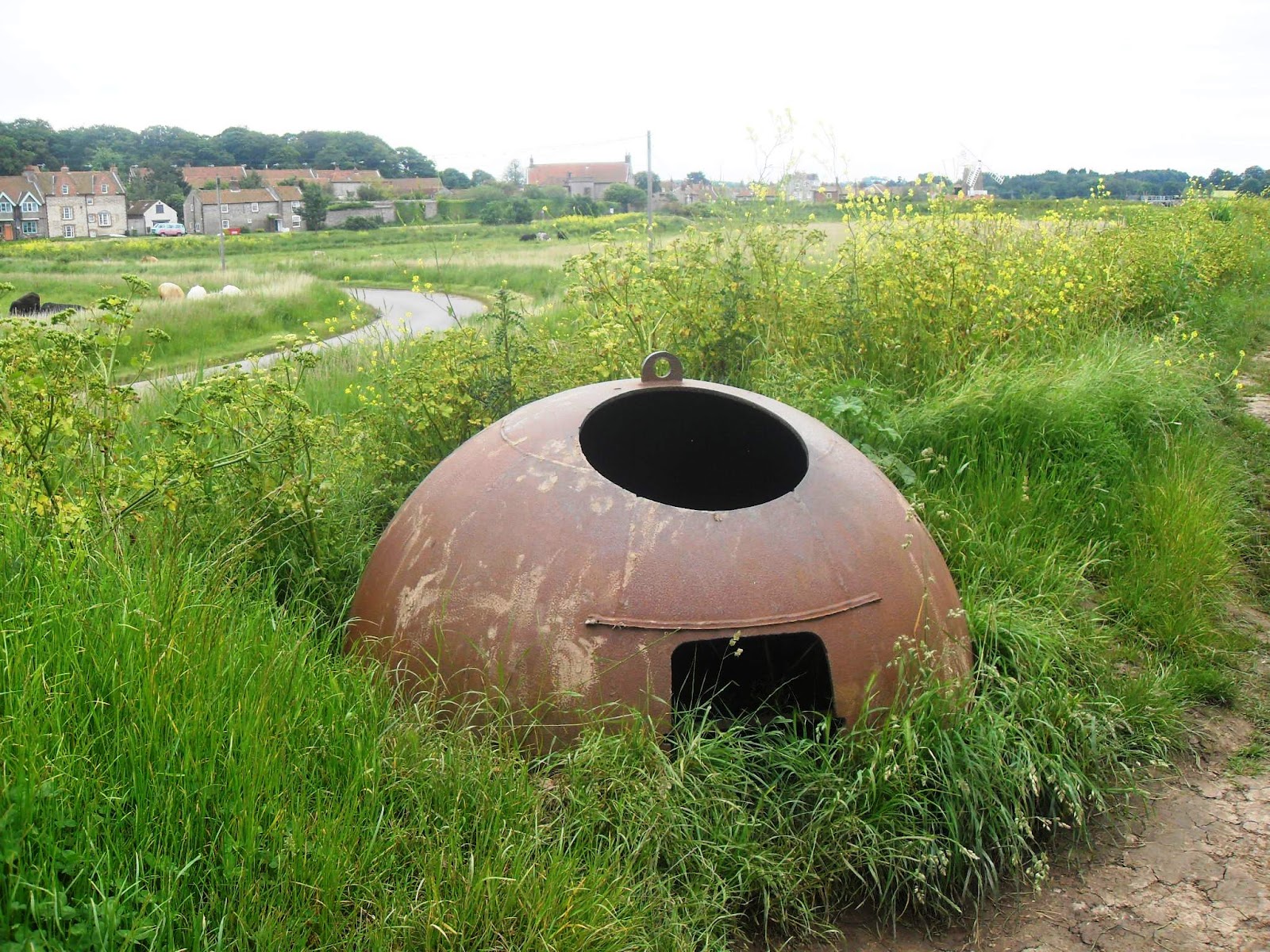

An Allan Williams turret still in situ on sea defences near Cley-next-the-Sea, which straggles across the low escarpment in the distance. I have written about this turret elsewhere, as I am quite taken by its mushroom like being among the grasses.

And, all across the area the rain had done wonders for the ox-eye daisies, the dog roses and the poppies that festooned the roadsides and the hedges, while fields of barley ran beneath the sea wind in this corner of England:


Thursday, 21 June 2012

Happy day...

... it's my holidays! I shall be away for a week, on holiday, in one of my favourite parts of England, my homeland. I have been holidaying in the area for nearly three decades, it is where this great Englishman grew up:


It is a land of great beauty, with high skies and long coasts, inlets, birds, salt marsh, pubs and churches:


I will leave you with a few stanzas from a notable contemporary Norfolk poet, and master of Anglo-Saxon poetry and prose, Kevin Crossley-Holland:

The blue hour ends, this world
floats on a great stillness.

I only guess where marsh
finishes and sky begins,

each grows out of the other.
In the creek a slip

of water gleams [...]


I'll be there this time tomorrow, god willing.


Monday, 18 June 2012

Cold War subject...

... and Cold War plastic. I began the Mig15 kit bash this evening, and it certainly is going to be a kit bash and some more. It is now very clear that I have a genuine bit of Cold War (and I mean 'classic' Cold War, not all that 1980s, SS20, Cruise Missile, Protect & Survive, dancing, prancing Greenham Cold War) kit on my hands. Starting with the cockpit tub, I added the resin ejector seat:


Let me digress for a moment ... the tin is, perhaps, of greater interest than the cockpit tub. The tin now contains bits of white metal off-cuts, some of which will go to weight the nose of the Mig, but, once, oh, once, the tin held the most divine of all pipe tobacco. I speak, sirs, of Peterson of Dublin's UNIVERSITY FLAKE. But, alas, the smoke is too perfect, too satisfying, so I avoid it now, as it weighs the game of pipe smoker's Russian roulette a little too heavily in favour of the demon,
 Nick O'Tine.

Back to the kit. Even in this photograph, it is clear that the cockpit tub is a heavy duty affair, but look at the 'detail' on the fuselage:

It looks like a steam punk's fantasy of a late Victorian boiler. I have resisted checking Mig 15 photographs in detail, as I would be very surprised if the panels match anything that existed in real life. I don't intend to totally remove all these bumps and lumps and then rescribe, but I will sand down a great deal. But this is not all. Below is the interior of the fuselage - a formless thing, with no location lugs for anything:


Yikes!

Sunday, 17 June 2012

Soviet classic...

... Rolls Royce engine. Uh? Just what did the UK government think it was up to? 'RR Nene, yes, of course, tovarish, and have some other products of our war winning aero-engine manufacturers while you are at it'. Oh well, it's all old hat now, ancient history. Odd, it was so  much part of our lives for what seem like aeons. But, it 'is one with Ninevah and Tyre!'.

Anyway, to see off flat fever (see previous posts), I've opted for an aircraft build. This has been sitting in my kit pile for six years, a Mig 15:


It's to be a basic kit bash, plus a little extra in the shape of a new resin ejector seat, and some after market decals.


The kit is a 'Kopro' kit (not sure if the company is still about), with raised panel lines and noticeable rivets, so it will be interesting to see how it goes together.

The after market decals are related to the theme of this magazine from November 2006 (is it still around?  I haven't seen it in the newsagents recently):


An interesting, well illustrated issue, with the Royal Navy and the French Navy still amounting to something. Carriers galore, aircraft and some more, ships aplenty. Yet the UK was a good deal less well off as a nation then than it is now. But there we go:

Far-called, our navies melt away;
On dune and headland sinks the fire:
Lo, all our pomp of yesterday
Is one with Ninevah and Tyre!

Yes, the old boy knew a thing or two, and ex-footballers nothwithstanding, there was a great deal more to his poetry than many give him credit for. But, that was a time when they could see what was shaping up for the century of horrors to come. Arnold did something similar with 'Dover Beach', and the squinty old Marxist nonsense (think Sartre) hardly proved to be a decent replacement.

On the soil front - ten bags of manure shifted into a trench, runner beans added. Around 70 leeks planted out, plus three rows of carrots. It still rains.

Saturday, 16 June 2012

Poor photographs...

... middling flats. I finished the British infantry for the War of 1812, this time with more accentuated highlighting. Still far from 'right', but, they'll do. But, my photographic skills are also less than A1, so the images don't really show the little flat fellows in all their (middling) glory:


The images above and below show the British ( a regiment with buff facings) posed against a Charles Grant style house.


The photograph below shows Canadians and British wending their way through the forests of Upper Canada to defend the freedoms of the King's subjects against Yankee Doodle:


Actually, I wonder if 'Yankee Doodle' was still called that by 1812, or did the foe have another nickname?

That's almost all my flats for the moment (apart from the Panzertruppen), and I feel in need of a complete change. Watch this space.

Friday, 15 June 2012

la lutta continua...

... our dim politicians struggle to think of what on earth they could do next, bankers struggle to keep the rest of us on our knees, Merkel struggles to be a bureaucratic Karl der Grosse, M. Hollande struggles with his mini-harem (or they with him - good job the top Frenchies have got their priorities right), and the Greeks just struggle. And I struggle to crack this flat painting malarkey:


Some work in progress. In the foreground, three members of the Panzerwaffe c.1940. I've had these since 1984, but they needed repainting because I had originally done them with camo overalls, despite their early war floppy berets (!!). The difficulty, of course, is painting black on these flats. Just the basecoat at the moment, but the only way forward that I can see is exaggerated highlighting. I think this just might be the general answer, and the War of 1812 British in the background have had the block colours highlighted much more than I would do with round figures. If you click on the image to enlarge it, the highlighting is a bit more apparent, but I may well have to be even more heavy handed.

But away from the struggles of high politics and flat painting, sanity can still be found in my Hobbit hole:

A brief bit of early morning sun warming my tiny greenhouse, where I smoked a pipe of London Mixture, and drank coffee. 
'Time grows young in a garden'.

Wednesday, 13 June 2012

A pick up...

... game. At last, the sound of rolling dice! Last summer, I was much taken by Bob Cordery's gridded wargame rules for Frontier and Modern games, based on the work of one of the great pathfinders, Joe Morschauser. I was also spurred on by Ross Mac's play testing, using ACW in 15mm, and Russian Civil War figures. So, I invested in more of the same, and produced a small tin box full of murderous Bolsheviks, and massacring Whites:


And, tonight, I had a spare hour or so, and an opponent, to get the little fellows out of their biscuit tin barracks. Here are the Whites:


First moves saw heavy play by the artillery on both sides as the infantry moved up to a meeting engagement:


The first close combat between the pointy-headed Bolsheviks, and the flat-capped Whites saw the Reds destroyed, which was in keeping with the early stages of the game. 


But, a sudden change in fortunes (the Whites feared some occult happening, while the Bolsheviks just took it as the hand of history) put the Whites under pressure. In quick succession, they lost three stands of infantry and the machine gun stand, leaving a ragged front under heavy Red artillery fire...


But worse was to come. An off-target Red artillery salvo hit the White command stand, and even Our Saviour couldn't save them...


The final straw was a highly symbolic dice throw by the White commander (me!). Heavily affected by this message, I called it a day.


A quick, enjoyable game - thanks Bob, and Joe.


And on another happy note, look what I found in the shed:

My long lost beer mats of London pubs for the Jolly Fun Wargames rules! Click on the image to remind yourself of England's glory - its pubs and history (with a little help from the odd Scot and Hanoverian).