Total Pageviews

Greetings!

'A gaping silken dragon,/Puffed by the wind, suffices us for God./We, not the City, are the Empire's soul:/A rotten tree lives only in its rind.'

Monday, 24 June 2013

Opening moves...

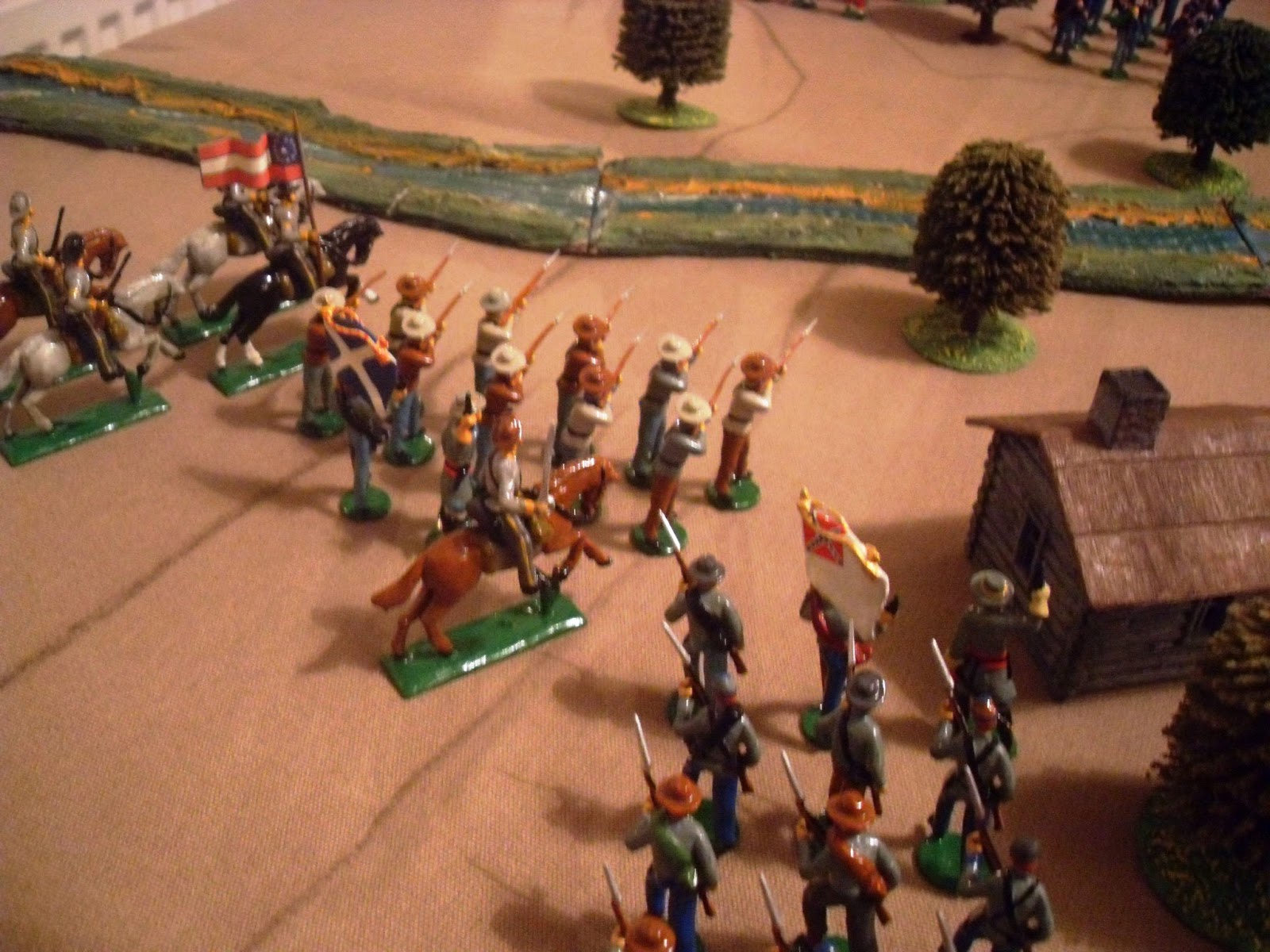
... after a quick hour with the hoe on the allotment plot, it was back to the play test of 'A Rattle of Dice' (ARD). Army Grey (or should that be 'Gray'?) is three regiments of foot, a squadron of cavalry, and a battery of field artillery. Army Blue is four regiments of foot and a battery of field artillery.


Army Gray's battle line - just look at those boys! Eager ? Yeeeeeehaaaaaa!!


More restrained, Army Blue leave their start line. The objective (for both armies) is the ford across the otherwise impassable river, seen upper left in the photo below:


Victory condition is holding both banks for three moves.

Army Blue won first advantage and began a general advance.


Army Gray surged forward too, pushing the cavalry squadron up towards the ford. Army Gray was also able to take advantage of the road, rapidly advancing (x2 bonus) in column. There was no penalty for change from column to line in 'ARD', but I added one in, of half a move. That still enabled the regiment in the centre above to advance close to the ford and form a firing line, waiting for the blue bellies...

Sunday, 23 June 2013

Mustered...

... for a Hobbit bunker playtest of Ross Mac's 'A Rattle of Dice':


42mm, classic toy soldier style (courtesy of Irregular Miniatures, in the city of York), shiny finish.


They may look suspiciously like Johnny Reb and Blue belly Yank,


But I'm going to play them as 'Army Grey' and 'Army Blue',


Just as soon as I get a bit of writing I've been contracted to do out of the way,


along with a few jobs on the allotment plot...


But, at least the little fellows have been mustered.

Thursday, 20 June 2013

At last...

... finished! Well, nearly. After much unexpected fussing (the large number of tiny stencil decals took two sittings to get on, and they're almost invisible against the hellblau), the Arado looks, more or less, the way it should:


Given that it is supposed to represent an Arado embarked on a free-roaming auxiliary cruiser, I tried to make it look worn, but not too much, as I suspect that it would have been kept hidden for much of the time.


As you can see, the floats alone sported a range of tricky stencils, marking the danger area for the prop, and the contents of the various hatches - spare mg ammunition, rations, first aid kit etc.


Not a bad looking kit for something so old. And I quite like the unusual overall blue finish, minus national markings.

The Skua is next up, but I think I'll have a quick foray into 42mm wargaming, as Ross Mac has recently posted some new rules - 'A Rattle of Dice'...

Sunday, 16 June 2013

Flies...

Right Off the Ground!  Yes, a FROG post. Today was 'Father's Day', and as a decent father (and son), I was cutting my mother's hedge when my own son came round with a really tip-top Father's Day present:


 Just look at this! Genuine, 100% not a reissue 1960s Classic Plastic! Oh, joy, oh, glory! Just looking at the box took me back through time and space. My main late 1960s/early 1970s source of kits and Airfix fighting men was a sports shop called Haskins in the small North-West town where I lived, but to buy FROG kits I had to walk to the next town, Hoylake (from where the asthmatic, Dutch-speaking King William III sailed to the Battle of the Boyne). I would walk down the cinder path between the railway and the municipal golf course, with the electric commuter trains (the carriages dating back to the 1930s, I think) droning past, and then I would emerge by the signal box and level crossing with its red lamp hung gates. Across the railway line and a bit further on and there was another sports shop, and this one was a FROG dealer, not an Airfix one. I'm not entirely sure now, but I think FROG were more expensive than Airfix. But, in any case, I can only remember buying a FROG 'Uhu', a Griffon engined Spitfire and V1 flying bomb, and a FAA biplane torpedo bomber (not a Swordfish, something a bit earlier). So, for me, my Father's Day gift has an aura of exotic expensiveness about it, as well as a distinct feeling of happy nostalgia. Thanks to my son.

And just look at the marvellous industrial, mass-produced, one size fits all, full employment, homogeneous perfection of the box contents:

Instructions (or, as my grandson calls them, 'constructions') on one sheet. And:


                                                                      A 'full' decal sheet.


With the parts displaying minimal detail (and no internal detail).  Aaaah, bliss.

But how is the Arado getting on? Slowly. For a simple 1970s mould, it is proving tricky. The canopy (in three parts) required a lot of careful masking:


Sadly, on completion of the masking, painting, then removal of masking, I found that paint had bled between the parts, sullying the finish from inside the cockpit! Aieeee.

But that's not all. The moulds might be from the 1970s, but the decal sheet is much, much more recent. Of course, my overall hellblau finish means that I will not be using the main markings, but there are more than enough stencils that I will be using. Just look at the stencils for the floats:


Yikes!

I managed to get a bit of work done on my allotment plot this weekend, and I even had a few moments sitting in my little garden, which, despite the chilly, wet weather is doing reasonably well. At least it comforts me. This is the view out of my downstairs window (I live in a terraced house with one room downstairs and two and a half up - England is a VERY crowded country with a bigger and bigger gap between the economic elite and the rest of us). I sit by this window and drink my pre-work coffee every morning:


Work. It's late Sunday evening now, and work in the morning. I could do with a permanent three day weekend - there's so much I want to do. Oddly, it occurred to me recently that my life is really a case of 'Work, Family, Country'. A fine slogan, except that it has been used (and abused) before. Just like all the others - 'Peace and Bread', 'Bread and Freedom' etc. But, for me, my life is, in fact, 'Work, Family, Country'. 

But in my Arcadia the yellow, climbing roses make a 'wall':


And, outside the kitchen door, by the drain, my Alpines dream of high pastures and rock faces:


Every time I water these pots by the kitchen drain I am reminded of the bit in one of George Orwell's books (it is probably The Road to Wigan Pier) when he sees, from a train, a young, dispirited woman poking at a blocked, back yard drain with stick. Happily, I have more than a yard (in the English, not the American sense), but I do remember the yards of my childhood, where my grandfather grew red, red geraniums, and the old mangle stood, rusting. 

Saturday, 8 June 2013

Hellblau...

With some industrial levels of sanding this evening, the Arado 196 has moved forward in the production process. I blogged yesterday that I was quite taken with the idea of finishing it in light blue overall, as one of the Arado 196s embarked on auxiliary cruisers in the early years of the war. This led to a very useful comment from a chap who has an excellent blog called, FalkeEins. A few years ago, FalkeEins exhibited a photograph of an Arado 196 in overall hellblau. The photo is, apparently, of an aircraft that was embarked on the 'Orion', and there are a few interesting things about it. Firstly, although the Arado is pretty well marked up with fuselage and wing crosses, there is no swastika on the tailplane. Secondly, the floats appear to be in a much darker finish than the rest of the aircraft. The photo might, I suspect, have been taken prior to the 'Orion' leaving for her deadly cruise in the Indian Ocean and beyond, as the photo in Dabrwoski and Koos' book shows a heavily damaged Arado which looks like this:


As you can see, this Arado carries no markings at all, and looking at the damage, perhaps it isn't too big a leap to suggest that this was why the 'Orion' ended up with a Nakijima E8N on board - the only German navy vessel to have operated a Japanese aircraft. And I think I will finish my Arado in the markings-less state, as befits what was a German version of a 'Q' ship.

Finally, while looking round the web for images of Arados, I came across this site , which provides a fair amount of information about the auxiliary cruisers, and includes a nice shot of the 'Komet' with an Arado on board.

Friday, 7 June 2013

Imperfection...

... and perfection.

The Revell Arado is, as I feared, turning into a 1970s horror story. It fits where it touches. Which is almost nowhere:


Just look at the horrible gaps around the float struts! And, of course, when I fill these it will be a devil of a job to sand without snapping off the struts.  But that's not all. Wing roots any one? -


Now I know the Arado 196 had folding wings, but I can't imagine the fit was this bad.

But I will persevere. I've been thinking about the finish for this kit. I know a few Arados sported Japanese markings (they were for the defence of a German U-boat base in the Far East), but I don't have any Jap markings in my decal box. Also, finding reliable information on these few aircraft is difficult. Another alternative was suggested  by this:

'As a ship-launched airplane on board Hilfskreuzern, which were conducting anti-maritime shipping operations in the Pacific and Indian Oceans the Ar 196 flew their missions without any particular markings other than a light blue paint job,'  Dabrwoski, H.P., & Koos, V., Arado 196; Germany's Multi-Purpose Seaplane (Schiffer Military History, 69, Atglen PA, 1993). 

The same book carries a photo of a unmarked Ar 196 in a pale, uniform, finish minus its entire engine, which had broken off in heavy seas. It may well have been the Arado 196 embarked on the auxiliary cruiser Orion as that same ship embarked a Nakijima E8N in early February 1941 - was that a replacement for the engineless Ar 196 in Dabrwoski and Koos' book?  So, I might well give my imperfect Ar 196 an overall blue (hellblau?) paint job.

And after the imperfection? Perfection. Climbing roses in my garden, photographed this morning before setting out for work:


Wednesday, 5 June 2013

The bells...

... the bells! Wednesday evening is bell ringers' practice evening at St. Mary's, Warwick. My allotment plot is about a quarter of a mile from the church, and I had a pleasant hour hoeing and watering there this evening, with the waves of sound echoing across the rooftops, the allotments and trees. The sky was doing its best to add to the general sense of rightness, with pale, water colour washed pinks and blues, and the sun was bright but subdued. There was a fair amount of traffic on the railway, with both the 'up' line (to Birmingham), and the 'down' line (to London) busy, not just with late passenger traffic, but also goods, and a train that was made up of London Underground carriages, odd goods wagons, and three diesel units. They were on the 'down' line, and I suspect they were coming from some repair yard. Perhaps Crewe? Where England used to make so many engines, carriages, wagons. But that was before the country that invented the railway stopped making the kit to run on it.

Every time I think of the 'up' and 'down' lines that run past my allotment plot, I think of the rather readable novel, Bhowani Junction, by John Masters. It's a decent middlebrow novel about love, Partition, Indian independence, and personal identity. It was later made into a film starring that rather scarily intense, out of control actress Ava Gardner (who would show any of today's Hollywood favourites a clean pair of heels), and, I think, Stewart Grainger. The novel is fascinating because it deals with some of the horrors of Partition (mmm, thinking Islamic intransigence again, that Jinnah chap, you know), but also because the key characters are Anglo-Indians. I suppose there must still be, of sorts, an Anglo-Indian community left in India (and I wonder if English-Indian marriages here in England now are a sort of Anglo-Indian community??), but for many years, the Anglo-Indians (i.e., mixed marriage families) were key to the operation of the Indian rail network, and, to some extent, the civil service. Needless to say, they didn't fare so well after 1947, and perhaps they fall into the sort of category that the descendants of white indentured serfs do in the Caribbean. I don't know. I have, somewhere in this Hobbit bunker, a fascinating book entitled Lost White Tribes, about the forgotten historical losers of European imperialism. Must look it out and read it again. Anyway, if you fancy a decent read about Indian railways, Partition, love (both in its human form and in the case of a man's love for a decent British motorbike), and the Anglo-Indians, then try Bhowani Junction. Masters was himself an Anglo-Indian - though he didn't care to admit it - so it has another interesting edge.