... To Be Done?
Not in the sense of Lenin's 1902 pamphlet of the same name. That was, of course, yet another step along the broad way to the genocidal hell that was much of the twentieth century. Instead, I asked the same question of myself this evening in respect of my innocent, child-like, kit bashing, toy soldierly past-times. After cogitating, I came, I think to an answer in the shape of these empty, forlorn, abandoned-looking vehicles:
Being various wargame Italian kit, including some captured British kit. A while ago I had lamented my lack of suitable crew figures, and was directed, by El Cake Tin, to these:
The two shall join in holy matrimony.
Total Pageviews
Greetings!
'A gaping silken dragon,/Puffed by the wind, suffices us for God./We, not the City, are the Empire's soul:/A rotten tree lives only in its rind.'
Wednesday, 4 June 2014
Sunday, 1 June 2014
Valom..!
Valom! For some reason that sounds like a Hebrew word for 'Zoom!' Do comics in Israel feature IDF aircraft flying low and fast over the Sinai with 'VALOM!!' printed next to them?
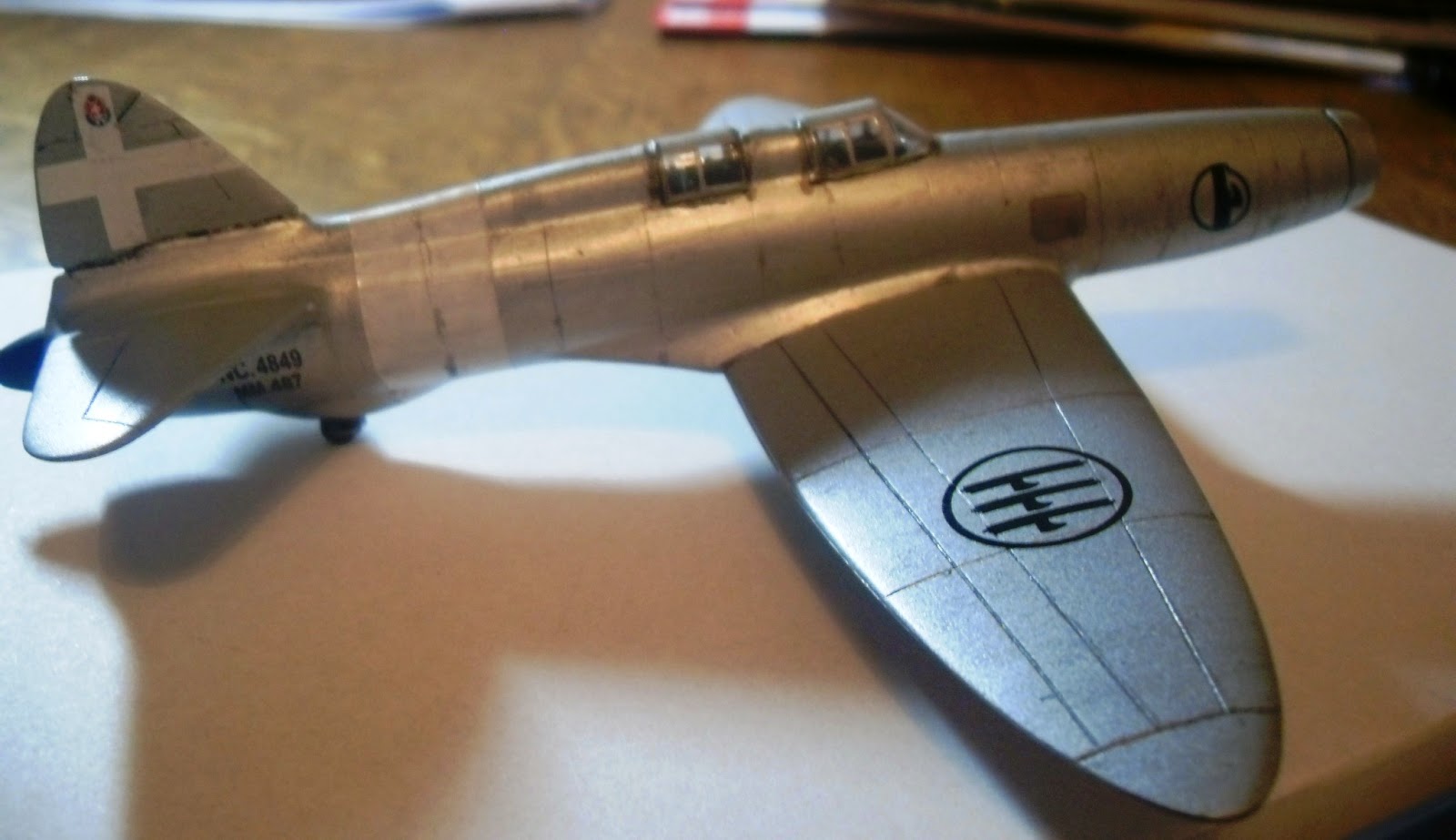
Actually, as any fool knows, Valom is a Czech (is it?) manufacturer of short run kits. Short run kits of interesting subjects. Interesting subjects to catch silly old kit bashers with poor eyesight and declining modelling skills. Chaps like me, in fact. And the interesting subject ? The Caproni Campini N.1. In 1940, the International Aeronautical Federation (FAI - French, you see), registered the Caproni Campini N.1 as the world's first jet aircraft. Actually, the cunning Jerries had already flown the He 178, but didn't tell anyone! The cads! Further, the Caproni wasn't a true jet, but, rather, flew using the ducted fan idea. But, enough of all that, and onto the kit:
Heavy, thick plastic, no location pins, fitted where it touched, and seen here at an early stage:
Right, that's it on short-runs for a while. I need an old style (1970s-1990s) kit, with no fiddly bits!
Actually, as any fool knows, Valom is a Czech (is it?) manufacturer of short run kits. Short run kits of interesting subjects. Interesting subjects to catch silly old kit bashers with poor eyesight and declining modelling skills. Chaps like me, in fact. And the interesting subject ? The Caproni Campini N.1. In 1940, the International Aeronautical Federation (FAI - French, you see), registered the Caproni Campini N.1 as the world's first jet aircraft. Actually, the cunning Jerries had already flown the He 178, but didn't tell anyone! The cads! Further, the Caproni wasn't a true jet, but, rather, flew using the ducted fan idea. But, enough of all that, and onto the kit:
Heavy, thick plastic, no location pins, fitted where it touched, and seen here at an early stage:
Despite the larding of filler seen above, I had to return with the green stuff again, and, eventually, finish it off with a combination of superglue and tippex as filler. And even then it wasn't right! The kit also came with a nice little fret of etched brass for the cockpit, but it was clear that none of it would be seen once the fuselage was closed up, so I saved myself the aggravation of sticking etched brass to my fingers.
Finally, I did produce something like the prototype:
Photographs of the original (there were two, plus a non-flying version for engine testing) show it as being pretty worn, and that's the finish I attempted.
As you can see, below, it was a pretty hefty bit of kit, and is actually a good deal bigger than the Me109G-6 I've posed it with here:
Right, that's it on short-runs for a while. I need an old style (1970s-1990s) kit, with no fiddly bits!
Tuesday, 20 May 2014
What...
... is it?
Having surfaced, briefly, from the depths of daily life into the happy sunshine of bits of plastic, smelly glues, and sharp cutty things, I was able to begin this project today:
Clearly, it is not the He115 that I spoke of, and that I will tackle soon, but what is it? Answers on a virtual postcard to Alf at the Hobbit Bunker, West Mercia.
As more regular readers of this blog will know, I have a passing interest in the British Home Guard during its first incarnation. Recent news that a film of the television series - 'Dad's Army' - that came to represent most British people's views of the force meant that I was asked to write this brief account for a relatively recent innovation in academic-popular e-magazine thingies.
Having surfaced, briefly, from the depths of daily life into the happy sunshine of bits of plastic, smelly glues, and sharp cutty things, I was able to begin this project today:
Clearly, it is not the He115 that I spoke of, and that I will tackle soon, but what is it? Answers on a virtual postcard to Alf at the Hobbit Bunker, West Mercia.
As more regular readers of this blog will know, I have a passing interest in the British Home Guard during its first incarnation. Recent news that a film of the television series - 'Dad's Army' - that came to represent most British people's views of the force meant that I was asked to write this brief account for a relatively recent innovation in academic-popular e-magazine thingies.
Friday, 2 May 2014
Lies !!
Lies !! It's all lies, I tell you!!!
If you have any interest in kit bashing aircraft you will know that among the various, much-touted techniques, the use of artist's oils is currently in vogue. Any sucker, sorry, reader, who persuses the pages of modelling magazines will meet with 'how to do it' accounts of smearing oils over their nicely painted models. The oils are wiped off after a while, using white spirit if necessary, and, hey presto, panel lines are all revealed and one's model is suitably weathered. But it is ALL LIES!!! See:
I can't bring myself to show a close-up of the oily mess that my second Tupolev has become. These blurred photos (rather like something from the old Cold War) will suffice:
Moving swiftly on... After my query in my last post re Norwegian He115s, the good blogger over on FalkeEins confirmed that there were two finishes sported by the Norwegian aircraft. The second finish involved the hastily applied camouflage shown below:
The photo shows two RAF officers on one of the Norwegian machines that made it to the UK. As for the finish - well, your guess is as good as mine. So, it looks like the choice will be this:
'FalkeEins' assures me (from a learned perspective) that this was overall aluminuim/silver, rather than grey; so I'll go for that. Cheers, FalkeEins!!
Back in the world of beauty and truth, i.e., the garden of a middle aged Englishman:
Another Iris - wonderful, beautiful. I give thanks !
If you have any interest in kit bashing aircraft you will know that among the various, much-touted techniques, the use of artist's oils is currently in vogue. Any sucker, sorry, reader, who persuses the pages of modelling magazines will meet with 'how to do it' accounts of smearing oils over their nicely painted models. The oils are wiped off after a while, using white spirit if necessary, and, hey presto, panel lines are all revealed and one's model is suitably weathered. But it is ALL LIES!!! See:
I can't bring myself to show a close-up of the oily mess that my second Tupolev has become. These blurred photos (rather like something from the old Cold War) will suffice:
Moving swiftly on... After my query in my last post re Norwegian He115s, the good blogger over on FalkeEins confirmed that there were two finishes sported by the Norwegian aircraft. The second finish involved the hastily applied camouflage shown below:
The photo shows two RAF officers on one of the Norwegian machines that made it to the UK. As for the finish - well, your guess is as good as mine. So, it looks like the choice will be this:
'FalkeEins' assures me (from a learned perspective) that this was overall aluminuim/silver, rather than grey; so I'll go for that. Cheers, FalkeEins!!
Back in the world of beauty and truth, i.e., the garden of a middle aged Englishman:
Another Iris - wonderful, beautiful. I give thanks !
Friday, 25 April 2014
Groundhog...
...Day.
Or deja vu all round. As most of us are aware, the Ukrainian/Russian crisis rumbles on, with various actors inside, and outside, those countries playing what may well be a rather dangerous game of silly buggers. I will resist the temptation to comment about multi-national states, partition, and disputed borders (we in the UK and Ireland, have had our own problems in those respects). However, the whole business is a tad depressing, though not without ironic light relief. The latter comes in the form of the totally unelected EU foreign policy Generalissimo, Baroness (how apt) Ashton, lecturing Putin on democracy. Putin is, of course, elected. But I have been a bit surprised at the speed with which parts of the UK media have wheeled out the Cold War rhetoric. However, every cloud, etc etc, and the BBC kindly supplied us aero-enthusiasts with some marvellous photographs of Russian 'Bears', intercepted by RAF Typhoons. They are well worth a look - here. Absolutely marvellous photographs - just look at the different finishes on various panels ! Aaaaah. But, more seriously, why show us this now, when, of course, it is a pretty standard event, ever since the temporary grounding of aircraft after the collapse of Bolshevism. Why now ? Why refresh old images in the minds of a good slice of the population?
And, that, of course, brings me to modelling Groundhog here at the Hobbit Bunker, in the shape of:
Now, I intend to finish this Heinkel He115 B as an Heinkel He115A (as far as can establish, there were no external differences between the two) of the Norwegian air force. But there is a tricky bit. My trawl of the internetosphere has come up with only three images of Norwegian He115s. Two appear to be pre-war, and one is, apparently, a photograph of one of the aircraft which escaped to the UK. The pre-war finish appears to be overall aluminuim/silver, while the escaped version has a heavy, field applied, random camouflage applied to the upper surfaces, but the colours are almost impossible to determine. Has anyone got any more concrete information on either finish???
In Old Blighty, Spring is well and truly here, and this is the view from my back window out into my tiny garden:
I enjoy this view as free Englishman with thanks to the men of the ANZAC. Long may their memory live.
Or deja vu all round. As most of us are aware, the Ukrainian/Russian crisis rumbles on, with various actors inside, and outside, those countries playing what may well be a rather dangerous game of silly buggers. I will resist the temptation to comment about multi-national states, partition, and disputed borders (we in the UK and Ireland, have had our own problems in those respects). However, the whole business is a tad depressing, though not without ironic light relief. The latter comes in the form of the totally unelected EU foreign policy Generalissimo, Baroness (how apt) Ashton, lecturing Putin on democracy. Putin is, of course, elected. But I have been a bit surprised at the speed with which parts of the UK media have wheeled out the Cold War rhetoric. However, every cloud, etc etc, and the BBC kindly supplied us aero-enthusiasts with some marvellous photographs of Russian 'Bears', intercepted by RAF Typhoons. They are well worth a look - here. Absolutely marvellous photographs - just look at the different finishes on various panels ! Aaaaah. But, more seriously, why show us this now, when, of course, it is a pretty standard event, ever since the temporary grounding of aircraft after the collapse of Bolshevism. Why now ? Why refresh old images in the minds of a good slice of the population?
And, that, of course, brings me to modelling Groundhog here at the Hobbit Bunker, in the shape of:
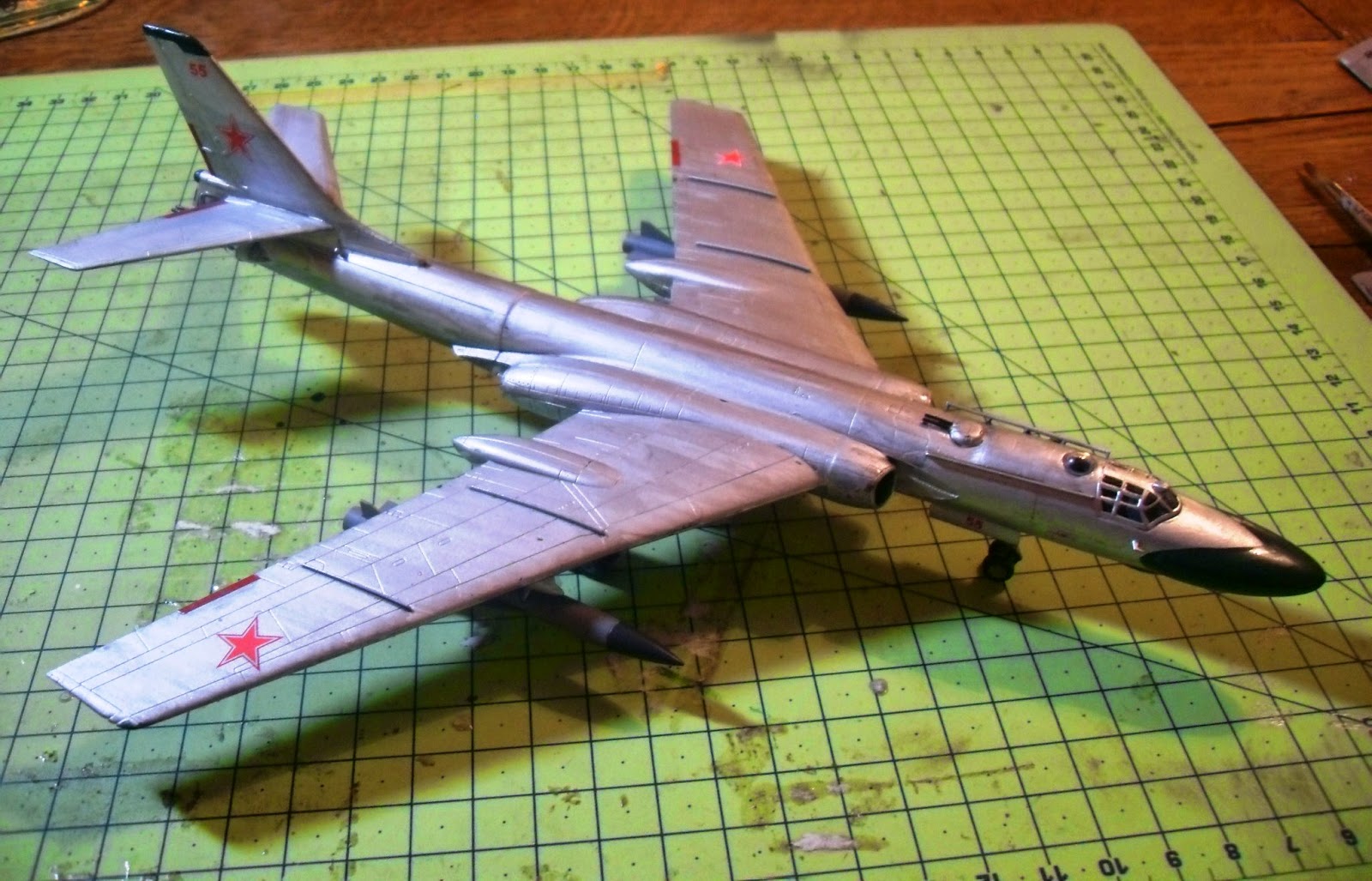
Yes, another 1/144 Badger, but a Badger G. Unlike my previous Tupelov, this one is being finished in over the water camouflage - gull grey over white:
I am clearly on a aircraft kit bash streak (although I have no idea at all where I will be able to squeeze them in among my packed shelves). I'm also into a long-range, sea strike mood, and last week I picked up:
Now, I intend to finish this Heinkel He115 B as an Heinkel He115A (as far as can establish, there were no external differences between the two) of the Norwegian air force. But there is a tricky bit. My trawl of the internetosphere has come up with only three images of Norwegian He115s. Two appear to be pre-war, and one is, apparently, a photograph of one of the aircraft which escaped to the UK. The pre-war finish appears to be overall aluminuim/silver, while the escaped version has a heavy, field applied, random camouflage applied to the upper surfaces, but the colours are almost impossible to determine. Has anyone got any more concrete information on either finish???
As you might expect of a toy soldier/kit bashing/war gaming odd bod, I also have small collections of other bits and pieces - or artefacts, if you will. I'm particularly pleased by a new acquisition to my small collection of Staffordshire figures, I think it is Grace Darling, and it is probably from the 1850s/60s:
A very nice piece, with overloaded cobalt that ran. One of millions, and a reminder of both of bravery and domesticity from times past. The figure to the right, by the way, is a modern figure but executed in a nice classic style. It is 'Napoleon', but looks like Rabbie Burns dressed for a party.
I enjoy this view as free Englishman with thanks to the men of the ANZAC. Long may their memory live.
Monday, 31 March 2014
Aaaaaaargh....
.....and aieeeee!
It works! It works! As you can see, I've been having fun with the rather marvellous Cold War warrior, the 'Badger'. I was rather taken by an enthusiastic build by Karl Robinson in the February issue of Scale Aircraft Modelling (SAM), and got myself a 1:144 one by Trumpeter. After the awful time I had with the new Airfix Vampire (see passim) , which I hasten to add was all my own fault, I can report that the Badger was most enjoyable, and I think that I may have found a new enthusiasm - large-ish Cold War warriors in 1:144.
Trumpeter produce different variants of the Badger, which probably dictated the fuselage construction, which in turn needed a fair amount of filler fore and aft. Mr. Robinson in his SAM build did a very good job at filling and sanding away the joins. Not so Mr Front:
Nonetheless, a rather pleasant kit bash. So much so that I've ordered another, and stocked up on Humbrol metalcote, which is good to work with, especially for an old brushist like myself.
While I was slowly bashing this kit over the past month, the whole Ukraine/EU/Russia/Crimea/Putin business was playing itself out. I was, I must admit, a bit surprised at the rapidity which the UK's journalists and mainstream politicians went for old Cold War style rhetoric at the drop of the hat, not least because it was the same politicos who have effectively dismantled the UK's armed forces. Not quite sure why one would want to go around trying to pick fights while championing cuts to the military, especially given the failure of Basra. In fact, mentioning Iraq brings John Kerry's laughable comment to mind - the one about not being able to go round invading countries on jumped up excuses. Uh? Pot, kettle ? Who said the US doesn't do irony (even if unintentionally).
Not only has work and life been stupidly obstructionist this past month, but when I found, at last, a moment to post on my feeble kit bashing efforts, I discovered that my work managed laptop, having been totally reconfigured, no longer liked to copy images from my portable device. What a lot of new words - laptop, portable device...blah, blah...all the jolly new words that have entered the English language in my recent-ish lifetime, just like Taliban, jihad, fatwa that sort of thing. It must have been a tad better in the past, when we picked up buckshee, char, chit-chat, bint, fella, kibosh, all useful, benign words. Anyway, enough of all that, time to see if I have cracked the newly reconfigured bloody hell machine:
It works! It works! As you can see, I've been having fun with the rather marvellous Cold War warrior, the 'Badger'. I was rather taken by an enthusiastic build by Karl Robinson in the February issue of Scale Aircraft Modelling (SAM), and got myself a 1:144 one by Trumpeter. After the awful time I had with the new Airfix Vampire (see passim) , which I hasten to add was all my own fault, I can report that the Badger was most enjoyable, and I think that I may have found a new enthusiasm - large-ish Cold War warriors in 1:144.
First up (below) was the cockpit, not much of which can be seen in the end. But, as you can see, I had a bit of trouble trying to get an approximation of the unique colour that the Soviets painted the cockpits of their aircraft.
Then, the weakest part of the whole thing:
Trumpeter produce different variants of the Badger, which probably dictated the fuselage construction, which in turn needed a fair amount of filler fore and aft. Mr. Robinson in his SAM build did a very good job at filling and sanding away the joins. Not so Mr Front:
Nonetheless, a rather pleasant kit bash. So much so that I've ordered another, and stocked up on Humbrol metalcote, which is good to work with, especially for an old brushist like myself.
While I was slowly bashing this kit over the past month, the whole Ukraine/EU/Russia/Crimea/Putin business was playing itself out. I was, I must admit, a bit surprised at the rapidity which the UK's journalists and mainstream politicians went for old Cold War style rhetoric at the drop of the hat, not least because it was the same politicos who have effectively dismantled the UK's armed forces. Not quite sure why one would want to go around trying to pick fights while championing cuts to the military, especially given the failure of Basra. In fact, mentioning Iraq brings John Kerry's laughable comment to mind - the one about not being able to go round invading countries on jumped up excuses. Uh? Pot, kettle ? Who said the US doesn't do irony (even if unintentionally).
Monday, 3 March 2014
What alchemy...
... has the good Herr Doktor Front been engaged in ? Why has he not updated his flaming blog?
Well, the Vampire struggle continues. Rescued from the shed, it has, this very evening, begun to receive its myriad decals. When did 1/72 aircraft kits begin to have more markings and stencils than they have parts? It's no good thinking that one can omit some of the stencils, the very small ones at least, because they will just call out from the decal box. They will call, in sad, thin voices, in the late watches of the night, when, as Nietzsche said, 'the thought of suicide is our only comfort' (well, he was a mad old beggar). So, decals, half done:
They are admirably thin decals, and, as you can see the roundels are in good register, with nicely opaque whites. But with the thinness comes the dreaded curl ! And, horrors, I discovered that on the yellow, they have an instant stick quality that has already seen one casualty (fortunately, I have a spare set of decals). When I make the next T11, it will be a Rhodesian version - no markings at all, not one !
pitch my little green tent (not unlike Snufkin's, though of a more modern form). A tent of this size used to be known as a 'pup tent'. Roomy for a pup, a squeeze for Alf, but light, and weather proof, and, above, in a small wood not from the village of Plumpton Green (yes, there is such) in the noble, beautiful county of Sussex.
From my tent, I journeyed out on Saturday morning, in amazing sunshine after rain, so much rain. First to the parish church of Streat:
Built on the site of a Saxon church by the Norman invader, this form is typical of this part of the county. Fairly plain, solid, simple, and with a turret, as opposed to a tower. From the church at Streat, I walked and slid a few miles across country to Ditchling, and sat in the church yard there, opposite this beauty:
'At this place the flat water-meadows, the same that are flooded and turned to a lake in mid-winter, stretch out a sort of scene or stage, whereupon can be planted the grandeur of the Downs...'
(Belloc, The Four Men (1904).
Well, the Vampire struggle continues. Rescued from the shed, it has, this very evening, begun to receive its myriad decals. When did 1/72 aircraft kits begin to have more markings and stencils than they have parts? It's no good thinking that one can omit some of the stencils, the very small ones at least, because they will just call out from the decal box. They will call, in sad, thin voices, in the late watches of the night, when, as Nietzsche said, 'the thought of suicide is our only comfort' (well, he was a mad old beggar). So, decals, half done:
They are admirably thin decals, and, as you can see the roundels are in good register, with nicely opaque whites. But with the thinness comes the dreaded curl ! And, horrors, I discovered that on the yellow, they have an instant stick quality that has already seen one casualty (fortunately, I have a spare set of decals). When I make the next T11, it will be a Rhodesian version - no markings at all, not one !
Apart from the continuing struggle with micro sol and set, I was able, this past weekend to :
pitch my little green tent (not unlike Snufkin's, though of a more modern form). A tent of this size used to be known as a 'pup tent'. Roomy for a pup, a squeeze for Alf, but light, and weather proof, and, above, in a small wood not from the village of Plumpton Green (yes, there is such) in the noble, beautiful county of Sussex.
From my tent, I journeyed out on Saturday morning, in amazing sunshine after rain, so much rain. First to the parish church of Streat:
Built on the site of a Saxon church by the Norman invader, this form is typical of this part of the county. Fairly plain, solid, simple, and with a turret, as opposed to a tower. From the church at Streat, I walked and slid a few miles across country to Ditchling, and sat in the church yard there, opposite this beauty:
The 'new' part of the house is, of course, the Elizabethan half-timbered structure on the right (part of the 'Great re-building', as the agrarian structure of England began some profound changes, and, some of the stolen silver began to tell - stolen by our English forbears from the Spaniards, who had stolen it from...the old story). The rest of the house, and it is still a private house, is a marvellous medieval structure, holding itself up with a series of drunken walls and a massive chimney breast. England made flesh, or, at least, made solid.
More recently, from inside St. Margaret's, Ditchling:
This is one of the crosses that marked a British soldier's grave from the Great War. Many were brought back to England (and the rest of the United Kingdom), as these temporary markers were replaced with the permanent ones that we are familiar with. Most of these temporary markers were then burned, ceremoniously, in parish church yards as part of Easter ceremonies following the war. Interestingly, the use of the cross as a grave marker in England had fallen out of use after the Reformation, but the huge citizen armies of the Great War brought back with them, from France and Belgium, a rekindled preference for the cross as a marker of Christian men. And, of course, there was the Kipling designed 'Cross of Sacrifice' that is the norm for many Imperial and Commonwealth Grave Commission cemeteries.
Then, I climbed out of Ditchling, up onto the Downs, and stood with Sussex, Surrey, and Kent before me:
land that the Saxons gave English names to, after they had breached the Romano-British coast.
And, finally, I rested:
'At this place the flat water-meadows, the same that are flooded and turned to a lake in mid-winter, stretch out a sort of scene or stage, whereupon can be planted the grandeur of the Downs...'
(Belloc, The Four Men (1904).
Subscribe to:
Posts (Atom)